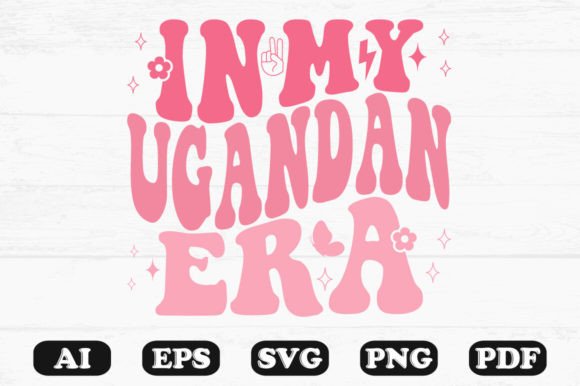
In My Ugandan Era Retro Wavy SVG: Graphics for Crafts & Local Branding
As a brand designer who’s developed visual identities for over 40 local businesses—from Kampala-based coffee roasters to handmade soap studios in Jinja—I approached In My Ugandan Era Retro Wavy SVG with both curiosity and caution. This isn’t just another vintage typography bundle from a creative marketplace. It’s a mood, a cultural nod, and a surprisingly versatile graphic design asset—if used intentionally.
A First Impression That Feels Warm, Nostalgic, and Uniquely Grounded
The moment I opened the file, I felt its rhythm: soft undulating curves, slightly uneven letterforms, and that gentle, hand-guided imperfection reminiscent of 1970s East African print ephemera—think old cinema posters, market banners, or community radio flyers. It doesn’t scream “luxury” or “corporate.” Instead, it evokes authenticity, warmth, and quiet confidence. For a small business branding project—say, a Kampala boutique selling handwoven baskets or a Jinja-based candle brand using local beeswax—In My Ugandan Era Retro Wavy SVG immediately suggests friendliness, heritage, and handmade care.
It reads as joyful but not childish, retro but not dated, decorative but not overwhelming. That balance is rare—and valuable—for local business owners who need marketing visuals that feel personal without sacrificing polish.
Where This Graphic Design Asset Earns Its Place in Real Business Use
I recently tested In My Ugandan Era Retro Wavy SVG across multiple touchpoints for a new Ugandan spice label line. Here’s where it delivered:
- Product labels: Used as a subtle top banner above the product name on kraft-paper pouches—it added instant character without competing with essential info like weight or origin.
- Packaging accents: Applied as a repeating border on hang tags for handmade soap bars; paired beautifully with natural cotton twine and minimalist typography.
- Social media graphics: Scaled cleanly into Instagram story templates for seasonal promotions (“Harvest Spice Bundle”), giving campaigns visual continuity and emotional resonance.
- Thank-you cards & printable inserts: Printed on recycled paper stock, the wavy text became a tactile signature—soft, memorable, and distinctly local.
- Menu graphics & price lists: For a pop-up café in Mbarara, we used the SVG as a decorative divider between sections—adding rhythm without clutter.
Crucially, it strengthened visual hierarchy: customers noticed the product name first, then lingered on the wavy phrase as an emotional anchor. That subtle lift improved shelf appeal, supported stronger first impressions, and deepened customer trust—not because it’s flashy, but because it feels *intentional* and *rooted*.
Where to Lean In—and Where to Step Back
This graphic design asset shines brightest when used as a supporting element—not the hero. It works exceptionally well on:
- Product mockups (especially for textiles, ceramics, or artisanal food packaging)
- Hero graphics for seasonal campaigns (“Ugandan Harvest Edition”, “Coffee Season Launch”)
- Boutique visuals—window decals, tote bag prints, or greeting card suites
- Social media campaign banners and story highlights
- Decorative brand elements: watermark textures, background motifs, or border treatments
But proceed carefully when:
- Designing formal corporate branding—its playful cadence clashes with strict governance guidelines.
- Applying to very small labels (<5mm height)—the curves lose legibility at tiny scales.
- Layering over busy or low-contrast backgrounds—test PNG transparency rigorously.
- Using alongside ingredient-heavy layouts (e.g., skincare or food labels with regulatory text)—it can distract from critical information.
- Supporting luxury minimalist brands—its warmth may dilute stark elegance.
Practical Designer Notes Every Small Business Owner Should Know
If you’re evaluating In My Ugandan Era Retro Wavy SVG for your own local business—or hiring a designer to use it—here’s what matters beyond aesthetics:
- Test on real packaging mockups—not just digital previews. Print it at actual size on your chosen material (kraft paper, linen, matte vinyl).
- Check black-and-white usage. Does it hold up in single-color print? (It does—but only if stroke weight remains visible.)
- Preview on small labels. At 8mm height, some letters blur. Reserve it for mid-to-large applications.
- Test with your brand colors. Try it over terracotta, ochre, deep indigo, or unbleached cotton tones—it sings with earthy palettes.
- Compare against competitor packaging. Does it differentiate your brand or blend in? In crowded markets like handmade soaps or roasted coffee, distinction is non-negotiable.
- Verify commercial licensing. Confirm it permits physical product sales, client work, and resale—not just personal use.
- Inspect SVG editability. Can you adjust spacing, isolate letters, or recolor individual elements? (Yes—the vector paths are clean and grouped logically.)
- Test font pairings. It harmonizes with warm sans-serifs (like Poppins Light), organic serifs (Cormorant Garamond), and even restrained script fonts—but avoid competing display fonts.
For creative entrepreneurs building a handmade business or launching a local food brand, In My Ugandan Era Retro Wavy SVG isn’t just decoration. It’s a shortcut to cultural resonance—when applied with restraint, clarity, and respect for context. Paired with thoughtful packaging design and consistent small business branding, it transforms generic products into meaningful, memorable experiences.
Used wisely, this SVG bundle becomes more than a digital product—it becomes part of your brand identity’s quiet voice, helping customers feel something before they even read a word.